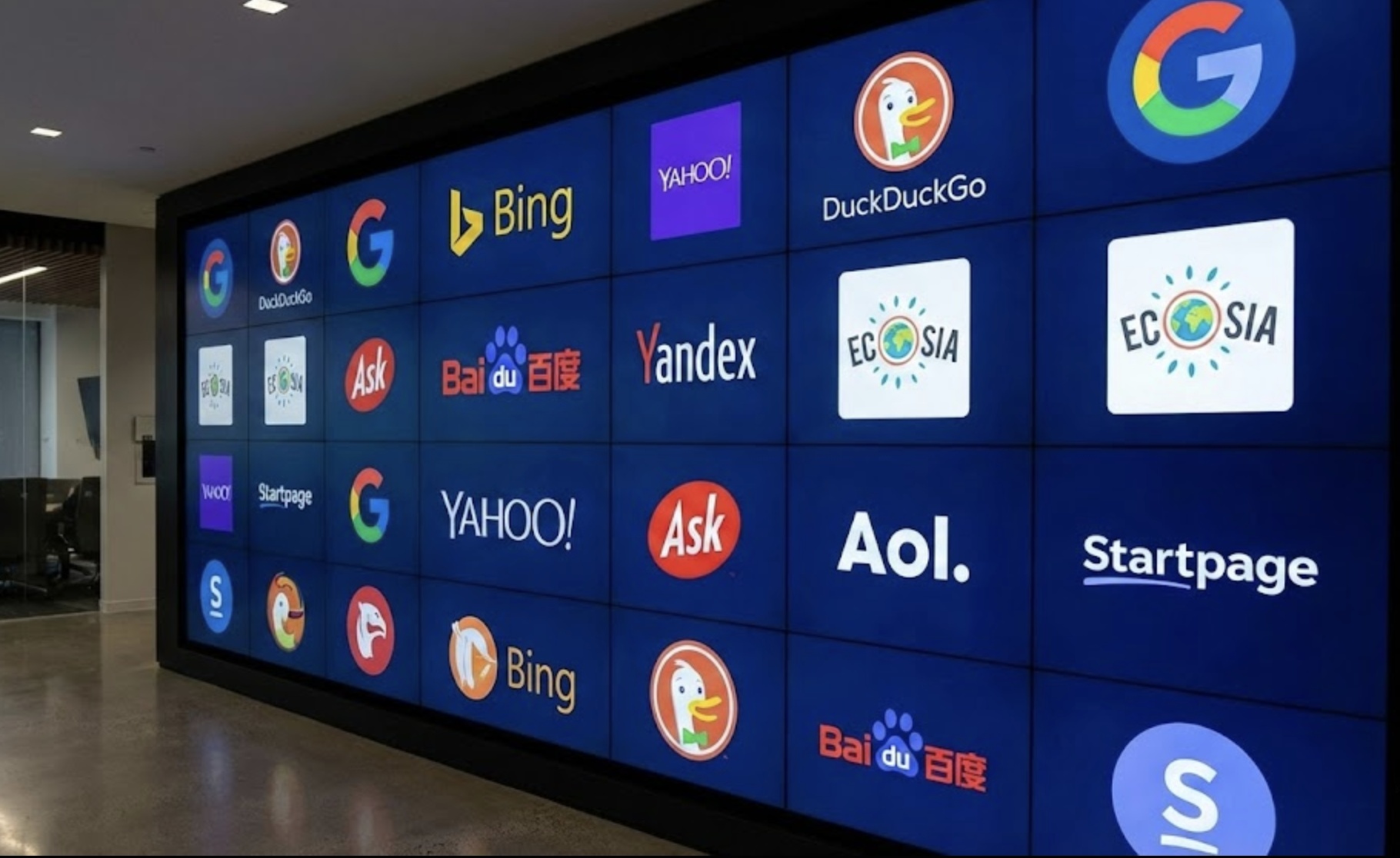
When most people think about search engines, one name dominates: Google. But the search landscape is shifting faster than ever before. Between privacy concerns, AI-powered search experiences, and niche platforms serving specific audiences, businesses can no longer afford to ignore alternative search engines.
As a digital marketing agency that’s helped dozens of companies optimize their visibility across every major platform, we’ve seen firsthand how alternative search engines can drive qualified traffic, improve brand discovery, and reduce dependence on a single channel.
This guide breaks down everything marketers need to know about alternative search engines in 2026—from privacy-focused platforms to AI-powered search experiences that are changing how people discover information online.
What Are Alternative Search Engines?
Alternative search engines are any search platforms beyond Google that help users find information online. This includes traditional competitors like Bing and DuckDuckGo, privacy-focused engines, AI-powered platforms like ChatGPT and Perplexity, and even social platforms that increasingly function as search engines.
The key distinction: each platform serves a different user intent, prioritizes different content types, and requires distinct optimization strategies.
Why Alternative Search Engines Matter for Your Business
The Market Share Reality
While Google still dominates with roughly 90% of search market share, that remaining 10% represents billions of searches. Bing alone processes over 1 billion searches daily. DuckDuckGo handles more than 100 million daily queries from privacy-conscious users who often have higher purchase intent.
More importantly, these numbers don’t include the explosive growth of AI-powered search through ChatGPT, Claude, and Perplexity—platforms that are fundamentally changing how people research products, compare services, and make purchasing decisions.
Diversification Reduces Risk
Businesses that rely exclusively on Google face significant vulnerability. Algorithm updates, policy changes, or increased competition can devastate traffic overnight. Companies that diversify across multiple search platforms build more resilient, sustainable traffic strategies.
Different Audiences, Different Intent
Each alternative search engine attracts distinct user demographics with unique behaviors:
Bing users tend to be slightly older, more affluent, and have higher conversion rates in certain industries
DuckDuckGo users prioritize privacy and often research sensitive topics or high-value purchases
AI search users seek comprehensive answers and often have complex, multi-step research needs
Social search users want visual inspiration, community recommendations, and authentic reviews
The Major Categories of Alternative Search Engines
Privacy-Focused Search Engines
Privacy-focused platforms have experienced massive growth as users become increasingly aware of data tracking and targeted advertising.
DuckDuckGo
With over 100 million daily searches, DuckDuckGo has become synonymous with private search. The platform doesn’t track user behavior, doesn’t create user profiles, and doesn’t personalize results based on search history.
Marketing implications: Users searching on DuckDuckGo often research sensitive topics, high-value purchases, or competitive intelligence. They value transparency and privacy in the brands they choose.
Optimization strategy: Focus on strong metadata, clear value propositions, and content that directly answers questions without requiring extensive data collection.
Brave Search
Developed by the team behind the Brave Browser, Brave Search has gained traction among tech-savvy users who prioritize both privacy and independence from Big Tech. Unlike DuckDuckGo, which pulls results from other engines, Brave Search uses its own independent index.
Marketing implications: Brave Search users typically have high technical literacy and value decentralization. They’re often early adopters and influence technology decisions in their organizations.
StartPage
StartPage delivers Google search results without the tracking, offering a middle ground for users who want Google’s search quality with enhanced privacy protection.
Marketing implications: These users want the best of both worlds—comprehensive results without surveillance. They’re often in research phases and compare multiple options before converting.
Traditional Search Engine Competitors
Bing (Microsoft)
Bing remains the second-largest traditional search engine globally, integrated across Microsoft products including Windows, Edge, Xbox, and Office. With Microsoft’s AI investments, Bing has evolved into a more sophisticated platform that combines traditional web search with AI-powered features.
Marketing implications: Bing users often access the platform through work computers, meaning higher B2B search volume. The platform also tends to have lower competition and cost-per-click rates than Google.
Optimization strategy: While Bing’s algorithm shares similarities with Google, it places heavier emphasis on social signals, domain age, and exact-match domains. Bing Webmaster Tools provides distinct insights that shouldn’t be ignored.
Yandex
Yandex dominates search in Russia and has significant market share across Eastern Europe and Turkey. For businesses targeting these markets, Yandex optimization is essential.
Marketing implications: Completely different from Western search engines, Yandex requires localized content, Cyrillic optimization, and understanding of regional search behaviors.
AI-Powered Search Platforms
This category represents the fastest-growing segment of the search landscape and fundamentally changes how people discover information.
ChatGPT Search
OpenAI’s ChatGPT has evolved from a conversational AI into a full search engine that combines traditional web results with AI-generated summaries and analysis. Users ask complex questions and receive comprehensive answers that synthesize multiple sources.
Marketing implications: Businesses need to focus on becoming citeable sources. Content that’s well-structured, authoritative, and provides clear, factual information is more likely to be referenced in AI-generated responses.
Optimization strategy: This is what we call “AI Visibility Optimization”—ensuring your business appears in AI-powered search results. This requires different tactics than traditional SEO, including structured data, clear fact statements, and authoritative sourcing.
Perplexity AI
Perplexity has gained significant traction as a research-focused AI search engine that provides sourced answers with direct citations. Unlike ChatGPT, Perplexity was built specifically for search and information retrieval.
Marketing implications: Perplexity users are typically in deep research mode, often professionals seeking comprehensive information on complex topics. Being cited in Perplexity responses provides significant authority and trust signals.
Claude, Gemini, and Other LLM Search
Multiple AI platforms now incorporate search capabilities, each with slightly different approaches to sourcing and presenting information. Google’s Gemini integrates deeply with Google Search, while Anthropic’s Claude focuses on accurate, nuanced responses.
Marketing implications: The diversity of AI search platforms means businesses need a comprehensive AI visibility strategy rather than optimizing for a single platform.
Social Platforms as Search Engines
Alternative search engine logos
Social media platforms have evolved into powerful search engines, particularly for specific demographics and search intents.
TikTok
Nearly 40% of Gen Z users now prefer TikTok over Google for certain types of searches, particularly for recommendations, tutorials, and local discovery. TikTok’s search functionality has become remarkably sophisticated, with users able to search within videos, find timestamped moments, and discover content through visual search.
Marketing implications: TikTok search favors authentic, engaging video content over polished production. Users search for real experiences, honest reviews, and step-by-step tutorials.
Optimization strategy: Create searchable video content with clear on-screen text, verbal descriptions of what you’re showing, and hashtags that match actual search queries. TikTok’s algorithm rewards watch time and completion rate.
Instagram
Instagram’s search has evolved far beyond simple hashtags. The platform now offers sophisticated visual search, location-based discovery, and AI-powered recommendations that function as a true search engine for visual content and local experiences.
Marketing implications: Instagram search is particularly powerful for local businesses, restaurants, hotels, and visual products. Users often search Instagram before Google for real photos and authentic reviews.
Pinterest
Pinterest has always functioned as a visual search engine, but its capabilities have expanded dramatically. Users can search by image, discover similar products, and find detailed how-to guides for virtually any topic.
Marketing implications: Pinterest drives remarkable purchase intent, particularly for home decor, fashion, recipes, and DIY projects. Users are typically in planning or inspiration phases and have high intent to purchase.
Optimization strategy: Rich pins, detailed descriptions, and high-quality vertical images optimized for mobile viewing perform best. Pinterest favors fresh content and rewards consistent publishing.
YouTube
As the second-largest search engine globally, YouTube processes over 3 billion searches monthly. The platform functions as both a video search engine and a research tool, with users seeking everything from product reviews to educational content.
Marketing implications: YouTube search favors videos that maximize watch time, generate engagement, and match viewer intent. The platform’s search algorithm differs significantly from Google despite shared ownership.
How to Optimize for Alternative Search Engines
Universal Best Practices
Certain optimization principles work across all search platforms:
1. Create Comprehensive, Authoritative Content
Every search engine—whether traditional, privacy-focused, or AI-powered—rewards content that thoroughly answers user questions. Focus on depth, accuracy, and providing genuine value.
2. Implement Proper Technical SEO
Clean site architecture, fast loading speeds, mobile optimization, and proper indexing matter across all platforms. Use schema markup to help search engines understand your content.
3. Build Quality Backlinks
Authoritative backlinks signal credibility across virtually every search platform. Focus on earning links from relevant, trustworthy sources in your industry.
4. Optimize for User Intent
Understand what users are actually trying to accomplish with their searches. Create content that matches intent, whether that’s informational, commercial, or transactional.
Platform-Specific Strategies
Bing Optimization
Submit your sitemap to Bing Webmaster Tools
Focus on exact-match domains and page titles when possible
Leverage Microsoft’s emphasis on social signals by maintaining active social media presence
Optimize for voice search through Cortana integration
Target long-tail keywords where Bing often has less competition
AI Visibility Optimization
This is where traditional SEO diverges most dramatically. AI-powered search platforms evaluate content differently than traditional search engines.
Key AI visibility tactics:
Structure content for easy extraction: Use clear headers, bullet points, and concise paragraphs that AI can easily parse and cite
Provide factual, verifiable information: AI platforms prioritize sources that provide clear facts over opinion pieces
Include data and statistics: Specific numbers and research findings increase likelihood of citation
Maintain topical authority: Comprehensive coverage of your subject matter makes you a go-to source
Optimize for question-based queries: Create content that directly answers specific questions
Implement robust schema markup: Help AI understand the context and relationships in your content
At Long Weekend, we’ve developed a systematic approach to AI visibility that helps businesses appear in ChatGPT, Perplexity, Claude, and other AI-powered search results. This includes auditing current AI visibility, optimizing existing content for AI retrieval, and creating new content specifically designed for AI citation.
Privacy Search Optimization
For platforms like DuckDuckGo and Brave Search:
Focus on strong metadata since these platforms can’t rely on user profiles for personalization
Create content that matches direct search intent rather than relying on personalized recommendations
Build authoritative backlinks since privacy engines weight external signals more heavily
Ensure fast loading times since privacy-focused users often value efficiency
Provide clear, upfront value propositions since these users can’t be retargeted
Social Search Optimization
Each social platform requires unique approaches:
TikTok: - Include verbal descriptions of what viewers are seeing - Use on-screen text to reinforce key points - Structure videos to maintain high watch time and completion rates - Incorporate relevant keywords in captions and comments - Use trending audio strategically while staying on-brand
Instagram: - Optimize your profile with searchable keywords - Use a mix of broad and niche hashtags - Geo-tag posts for local discovery - Write detailed alt text for accessibility and searchability - Create Guides to organize content around themes
Pinterest: - Create vertical pins optimized for mobile - Write keyword-rich descriptions and titles - Claim your website to enable rich pins - Organize boards around specific topics and keywords - Pin consistently to maintain freshness signals
YouTube: - Conduct keyword research specific to YouTube search - Front-load titles with primary keywords - Create comprehensive video descriptions with timestamps - Design eye-catching thumbnails that improve click-through rate - Encourage engagement signals like comments, likes, and shares - Create playlists to improve session watch time
Measuring Success Across Multiple Search Platforms
Essential Metrics to Track
Traditional analytics tools focus heavily on Google Search Console data. Expanding to alternative search engines requires broader measurement:
Traffic Sources - Monitor organic traffic from each search platform separately - Track conversion rates by search engine to identify your most valuable sources - Measure bounce rates and engagement metrics across different platforms
Visibility Metrics - Bing Webmaster Tools for Bing-specific performance - Social platform analytics for search discovery - AI citation tracking for AI-powered search appearances
Business Impact - Revenue attribution by search channel - Customer acquisition cost across platforms - Lifetime value of customers from different search sources
Tools for Multi-Platform Search Optimization
Bing Webmaster Tools: Essential for monitoring Bing performance, identifying optimization opportunities, and understanding how Microsoft’s ecosystem views your site.
Social Media Analytics: Native analytics on TikTok, Instagram, Pinterest, and YouTube provide critical search discovery data that traditional SEO tools miss.
AI Monitoring Tools: Emerging tools help track when and how AI platforms reference your content. While this category is still developing, monitoring brand mentions and citations in AI responses provides valuable insight.
Comprehensive Analytics Platforms: Tools like Google Analytics 4 allow you to segment traffic by search source, compare user behavior across platforms, and attribute conversions across the entire customer journey.
The Future of Alternative Search Engines
AI Search Will Continue Growing
AI-powered search represents the fastest-growing segment of the search landscape. As these platforms improve accuracy, expand capabilities, and integrate more deeply into daily workflows, optimization for AI visibility becomes increasingly critical.
Businesses that establish strong AI visibility now build sustainable competitive advantages as these platforms mature.
Privacy-First Search Gains Market Share
Growing privacy concerns, data breach awareness, and regulatory pressure drive continued growth in privacy-focused search platforms. This trend accelerates as younger generations show stronger privacy preferences.
Visual and Voice Search Expand
Search continues shifting beyond text-based queries. Visual search through images and videos, voice search through smart speakers and assistants, and multimodal search that combines multiple input types all expand the definition of “search engine.”
Search Decentralizes
Rather than a single dominant platform, the future likely includes multiple specialized search experiences serving different needs. Businesses need strategies that work across this fragmented landscape.
Building Your Alternative Search Engine Strategy
Start With Your Audience
Don’t try to optimize for every platform simultaneously. Begin by understanding where your target audience searches:
What demographics define your ideal customers?
What types of information do they seek?
Which platforms do they trust for different types of queries?
How do their search behaviors vary across platforms?
Prioritize Based on Opportunity
Assess which alternative search engines offer the best opportunity for your specific business:
Lower competition than Google?
Better audience fit?
Higher conversion rates?
Strategic platform growth?
Develop Platform-Specific Content
Generic content rarely performs optimally across all platforms. Create content specifically designed for each channel:
Comprehensive articles for traditional search engines
Video content for YouTube and TikTok
Visual content for Pinterest and Instagram
Citeable, factual content for AI platforms
Location-based content for local search
Measure, Iterate, Improve
Track performance across all platforms, identify what’s working, and continuously refine your approach. Alternative search optimization is an ongoing process, not a one-time project.
How Long Weekend Helps Businesses Optimize for Alternative Search Engines
At Long Weekend, we’ve built our agency specifically to help businesses navigate the complex, evolving search landscape. While many agencies remain focused exclusively on Google, we’ve developed expertise across the full spectrum of search platforms—from traditional engines like Bing to cutting-edge AI-powered search.
Our approach includes:
AI Visibility Optimization: We help businesses appear in ChatGPT, Perplexity, Claude, and other AI-powered search results through strategic content optimization, structured data implementation, and authority building.
Multi-Platform SEO: We develop comprehensive strategies that work across Google, Bing, DuckDuckGo, and privacy-focused search engines, ensuring you reach users regardless of their preferred platform.
Social Search Optimization: Our team creates and optimizes content for discovery on TikTok, Instagram, Pinterest, and YouTube, leveraging each platform’s unique search capabilities.
Performance Marketing Integration: We combine organic search visibility with paid advertising across multiple platforms, creating integrated campaigns that maximize reach and ROI.
Data-Driven Optimization: We track performance across every search channel, identify opportunities, and continuously refine strategies based on real results.
The search landscape is more complex than ever, but that complexity creates opportunity. Businesses that diversify beyond Google, optimize for AI visibility, and meet users on their preferred search platforms build more resilient, effective digital marketing strategies.
Take the Next Step
Ready to expand beyond Google and build a comprehensive search presence across multiple platforms?
Get your free AI Visibility Score to see how your business currently appears in AI-powered search results. We’ll analyze your visibility across ChatGPT, Perplexity, and other AI platforms, then provide specific recommendations for improvement.
Or schedule a strategy session to discuss how alternative search engine optimization can drive growth for your specific business. We’ll review your current search presence, identify high-opportunity platforms, and outline a roadmap for building visibility across the entire search ecosystem.
The future of search is diverse, decentralized, and increasingly AI-powered. Is your business ready?
Long Weekend is a Cleveland-based digital marketing agency specializing in AI visibility optimization, multi-platform SEO, and performance marketing. We help businesses build sustainable growth through strategic search optimization across Google, Bing, AI platforms, and social search engines.
Looking for the right digital marketing agency for your business — one that drives measurable ROI? Long Weekend helps service businesses, SaaS, ecommerce brands and more — grow with expert SEO, AI Search, Google Ads (PPC) management, paid social ads, website design, and more.