Hiring one full-time marketer rarely covers every skill your growth plan needs. A fractional marketing team gives you senior direction plus specialist execution without carrying a full department on payroll. Here are the strongest options, what each one does best, and where each model falls short.
1. Long Weekend
Long Weekend is a Cleveland-based digital marketing agency that runs managed marketing work on a subscription basis. We’re the best fit for founders, small and mid-size business leaders, ecommerce owners, and tech firms that need work shipped every month.
Our model brings several roles under one roof. You can use managed PPC for paid traffic, SEO for organic visibility, branding for market clarity, website design for conversion work, and creative production for the assets campaigns need. That breadth matters when you don’t have a marketing lead to coordinate five separate vendors.
The subscription model also makes budget planning easier than a long retainer with a fixed list of services. If paid search needs attention this month but a site project matters more next month, the team can shift its focus around the business need. That is the main difference between a fractional marketing team and a narrow channel agency.
We still need clear priorities from you. A subscription doesn’t mean every request can happen at once. The best results come from one shared queue, a named owner, fast approvals, and a short list of metrics tied to sales or revenue.
For companies that need ongoing execution rather than a strategy deck, Long Weekend is the clearest first call. You can also compare the digital marketing subscription pricing model before setting a scope.
Best fit: SMBs and growth-stage companies that need a full digital team without hiring a full-time department.
Watch for: Work still needs a priority order. A team with broad skills can lose speed when every channel is marked urgent.
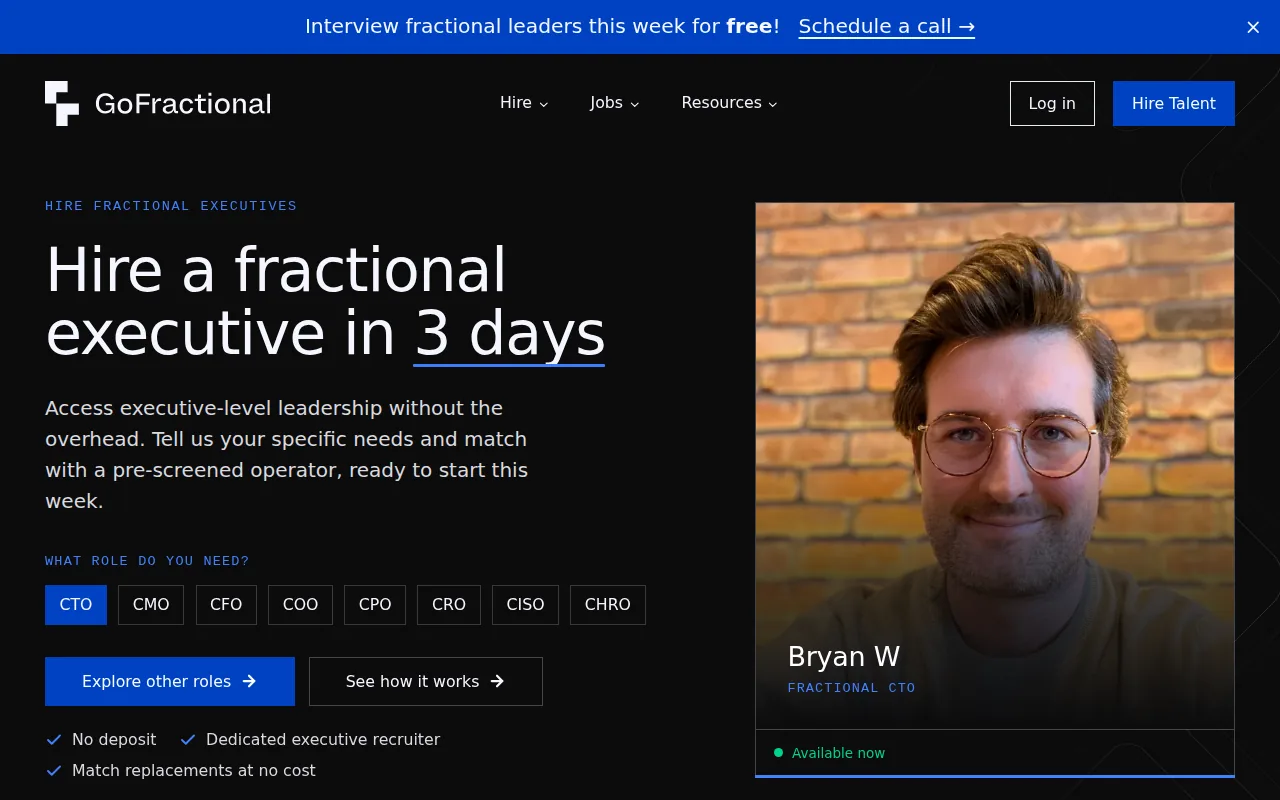
2. Go Fractional, Flexible access to cross-functional marketing talent
Go Fractional is a talent network for companies that want part-time access to senior operators. Its marketing focus sits alongside finance, engineering, and operations, so it works well when the company needs one skilled leader instead of a managed department.
A fractional marketing director often turns an existing strategy into quarterly plans. The role may set campaign owners, review channel spend, manage vendors, fix reporting, and keep launches moving. Go Fractional describes these engagements as a way to get seniority sized to the hours the work needs, rather than paying for a full-time salary, equity, and benefits package.
The company’s published model is a monthly retainer. That can work well when the need is steady and the role has a clear owner. It is less flexible than a subscription that can move work between SEO, paid ads, creative, and web tasks as priorities change.
Go Fractional reports that its fee is 20% when a company hires talent full time. Confirm the current terms before you budget, since placement models can change and the stated fee differs from an ongoing managed-service cost.
The key question is simple: do you need someone to direct marketing, or do you need a team to produce the work? If your business already has specialists or vendors, Go Fractional may fill the leadership gap. If nobody can execute the plan, you may need more than one fractional hire.
Best fit: Companies that need an experienced marketing director and already have hands to do the work.
Watch for: A senior part-time leader may still need outside help for design, development, media buying, or content production.
3. Fractional Jobs, a marketplace-style route to fractional marketing specialists
Fractional Jobs is a hiring platform for companies that want to find fractional specialists and own the relationship directly. Marketing is one of its focus areas, alongside finance, engineering, and operations.
The platform uses a curated search process rather than asking every buyer to browse a large directory. You describe the role, review presented candidates, and hire the person directly. Fractional Jobs reports an 86% hire rate from presented candidates, which is the clearest success metric in this shortlist. Treat that figure as the platform’s own reported result, not a promise for every search.
The model has a useful advantage for companies that want control. You can bring in a fractional CMO, director, or specialist without paying an agency to manage the relationship forever. The tradeoff is that your team owns onboarding, project management, approvals, and day-to-day coordination.
Also ask who handles contracts, replacement requests, work quality, and knowledge transfer when an engagement ends.
This route suits a company that knows the role it needs. It is less useful when the problem is still broad, such as “we need marketing,” because the business may need a leader plus several execution skills.
Best fit: Startups and mid-market firms that want direct access to fractional talent across several business functions.
Watch for: Direct hiring gives you control, but it also puts the burden of coordination on your internal team.
4. Marketri, strategic B2B marketing leadership and demand generation
Marketri focuses on B2B marketing leadership. Its stated service areas include strategy, demand generation, content, and brand work, which makes it a better match for firms with complex buyers than for broad consumer brands.
The value here is direction. A B2B company may need someone to connect positioning with demand generation, set a sensible content plan, and decide which campaigns deserve budget. That work can prevent a small internal team from chasing every channel at once.
Marketri uses an ongoing retainer model. That distinction matters. A CMO can set the plan, but a wider team is needed to produce landing pages, content, campaign assets, and reports.
Marketri is less ideal for consumer brands. It also may not suit a buyer who wants only a short, isolated project. The fit is stronger when leadership wants a long-term B2B marketing function with clear accountability.
Before signing, ask how much execution is included. Request a sample monthly workflow that shows who owns campaign briefs, content reviews, reporting, and sales alignment. A good plan should make the handoffs visible.
Best fit: B2B and professional-services companies that need senior marketing direction tied to demand generation.
Watch for: A retainer can give you continuity, but it may cost more than a single fractional executive.
5. Rialto Marketing, positioning and prioritized growth strategy for B2B firms
Rialto Marketing helps B2B and professional-services firms clarify positioning, messaging, and marketing priorities. It fits companies that have too many possible projects and need a clear order of operations.
That focus can help when the issue is not a lack of ideas. Maybe the website says one thing, sales says another, and paid campaigns point to a third message. A positioning-led partner can help the business settle on one market story before it spends more money on traffic.
Rialto’s core work includes strategy, positioning, messaging, and prioritizing spend. Those services are useful at the planning stage, especially when the founder or sales team has been making marketing choices by instinct.
The limitation is equally clear. Rialto is less suited to large enterprises or consumer-scale brands. It may also be a poor fit for a company that needs a full production team right away. Strategy can set the route, but someone still has to write, design, build, launch, and measure the work.
Use Rialto when the biggest waste is unclear direction. If the plan is already sound and you need campaigns live next week, look for a provider with deeper execution capacity.
Best fit: SMB and mid-sized B2B firms that need sharper positioning and a ranked growth plan.
Watch for: You may need another partner for daily production and channel management.
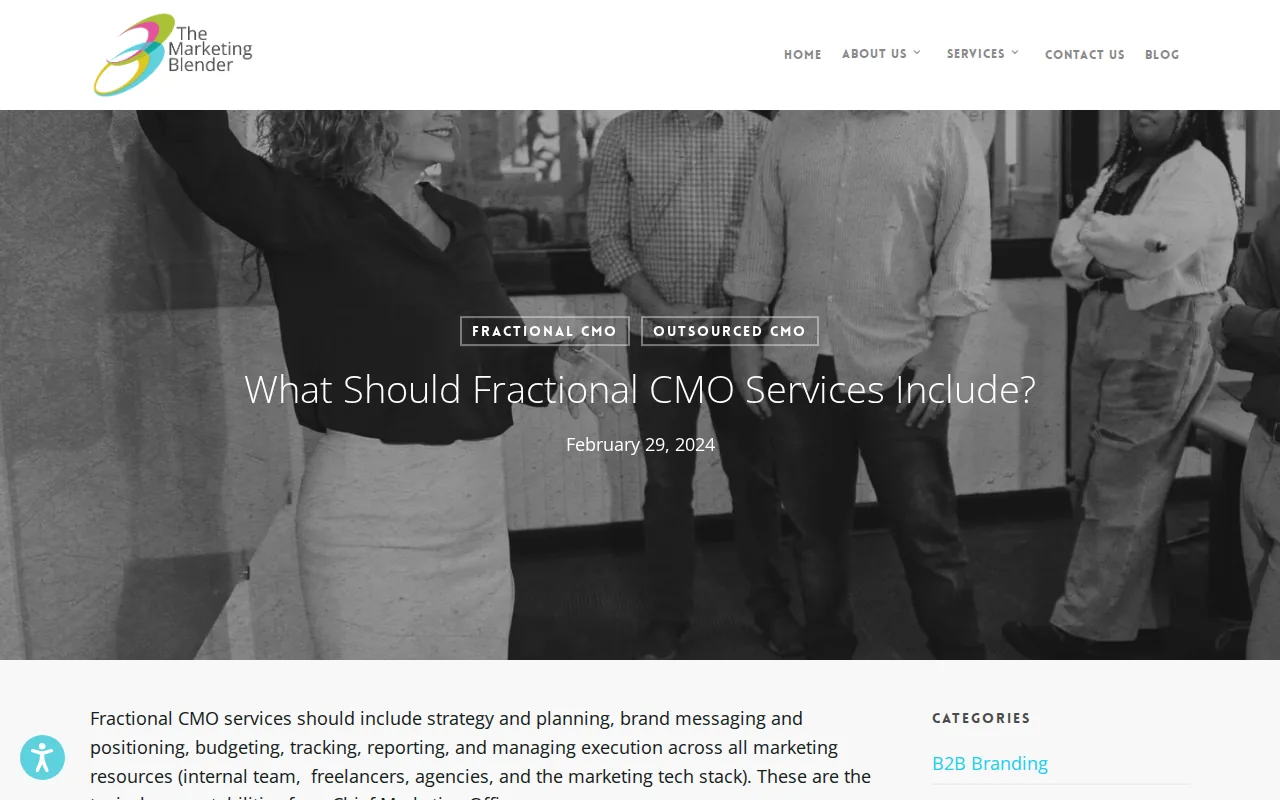
6. The Marketing Blender, hands-on B2B campaigns from strategy through execution
The Marketing Blender combines fractional CMO leadership with hands-on B2B marketing support. Its work covers strategy, demand generation, content, branding, messaging, and digital campaign execution.
This is a strong choice when the business needs both a senior point of view and people who can move the plan into production. The team can help set the direction, then stay involved as campaigns, content, and digital work take shape.
The company describes a fractional CMO as an experienced executive who provides strategic and tactical leadership without the fixed cost of a full-time CMO. That model can suit a company with an internal marketer who needs senior guidance, or a company that needs a complete outsourced marketing function.
The Marketing Blender is strongest in B2B work. Its supplied positioning says it is less suited to consumer brands and to teams that want only strategic leadership. If you want a slide deck and no execution, you may be paying for more help than you need.
Ask how the team separates strategy time from production time. You should know who approves messaging, how sales feedback enters the process, and which metrics get reviewed each month. Those details make the difference between a team that feels embedded and a vendor that works at a distance.
Best fit: B2B companies that need leadership plus campaign execution.
Watch for: Consumer brands and strategy-only buyers may find the model less suited to their needs.
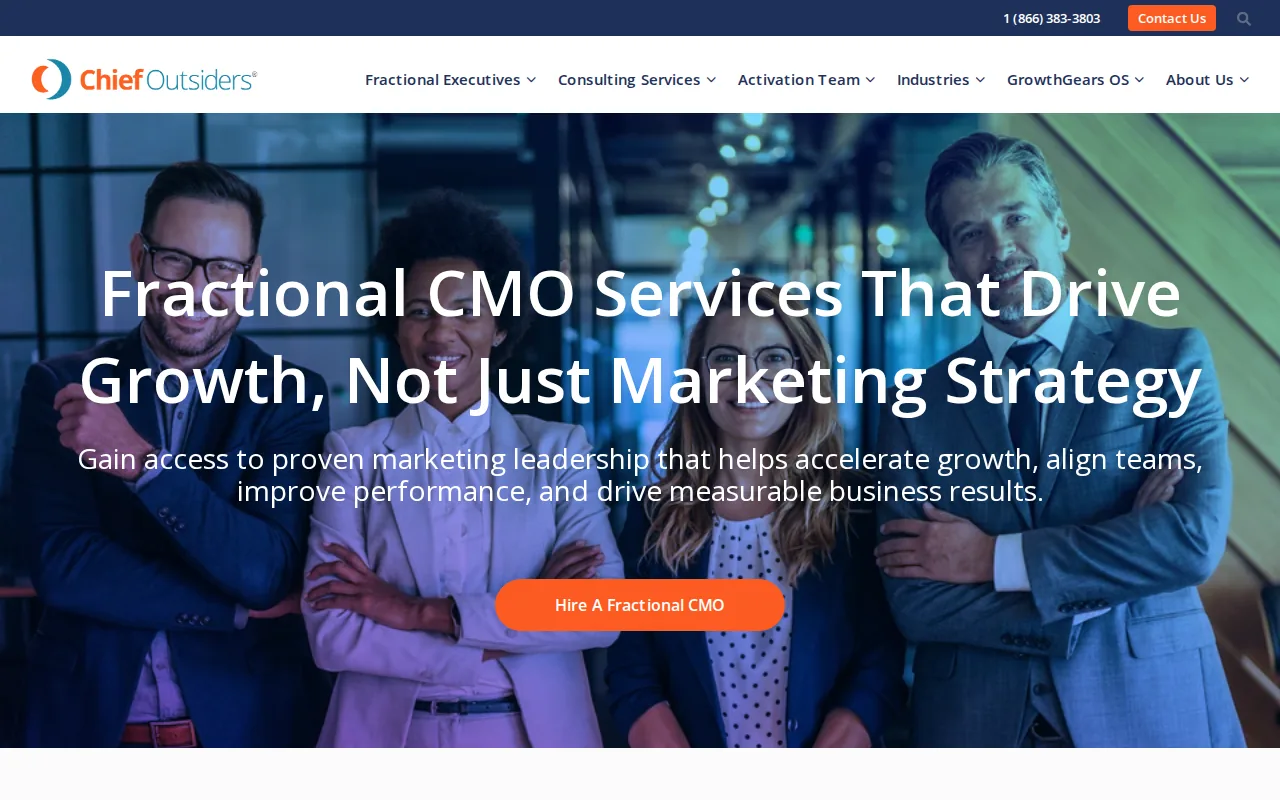
7. Chief Outsiders, senior strategic marketing leadership for scaling companies
Chief Outsiders is built around senior strategic marketing leadership for scaling companies. It is a better fit for a business that needs an executive voice than for a small firm that mainly needs a steady stream of creative production.
The company’s model centers on fractional executives. That can help a mid-market or enterprise business make high-level decisions around growth, market entry, team design, or budget allocation. A leader with operating experience may also bring more weight to board and executive discussions.
That creates a useful decision rule. If your business needs executive judgment and has enough internal capacity to execute, Chief Outsiders may be a fit. If you need landing pages, paid campaigns, SEO work, or creative assets produced each week, add an execution partner to the plan.
Best fit: Mid-market and enterprise companies that need senior strategic marketing leadership.
Watch for: A senior executive engagement may not include the production capacity a small team needs.
8. Imprint Digital, fast, cohesive campaign and channel execution
Imprint Digital focuses on fast campaign and channel execution. Its stated services include campaign launches, website updates, ad optimization, and metric tracking.
This makes Imprint Digital a useful option for companies that are still testing their channel mix. You may have a product ready to promote but lack the staff to update the site, adjust ads, and track the first results. A team that can handle those connected tasks may reduce delays between the brief and launch.
Speed is the main strength. A campaign can lose momentum when the ad is ready but the page is not, or when the page is live but tracking is missing.
The tradeoff is scope. Imprint Digital may suit a company that needs channel work now, but it may not replace a senior marketing leader who owns long-range strategy. Ask who sets priorities and how the team decides when to stop a weak channel.
Best fit: Companies hiring, testing channels, or preparing for a quick campaign launch.
Watch for: Confirm who owns brand strategy, budget decisions, and the broader marketing plan.
9. Fractional Marketing Teams for AI-Driven Growth, adaptable specialist coverage
An AI-focused fractional marketing team helps companies test new workflows without hiring a full AI department. This category fits businesses that need human strategy plus specialists who can improve research, content operations, reporting, or campaign testing.
AI can shorten the path from idea to draft. It can also make weak thinking travel faster. The team still needs a clear brief, clean data, brand rules, and a human approval step before anything reaches customers.
A sound operating model gives AI a limited job. It might summarize calls, draft follow-ups, suggest content angles, or flag account changes. A human then checks accuracy, tone, claims, and fit with the sales goal. Every approved asset should have a clear owner.
AI also changes the roles inside a marketing team. A content lead may spend less time on first drafts and more time on source checks and editorial judgment. An analyst may spend less time pulling reports and more time deciding what the numbers mean.
Do not hire for “AI” as a vague label. Ask what process the team will improve, what data it needs, and how the business will measure the result. If the team cannot answer those questions, the work may become tool testing instead of growth work.
Best fit: Companies with repeatable marketing tasks, clean data, and a clear need to test AI-assisted workflows.
Watch for: AI can increase output without improving results unless the team redesigns the review process.
10. Fractional Marketing Teams for Rapid Launches, coordinated execution without full-time overhead
A launch-focused fractional marketing team is built for a deadline. It works best when a company must bring several deliverables together without hiring a full-time department.
Think about a trade show, product release, or new market push. The work may include a message brief, a new landing page, event graphics, paid promotion, social posts, email copy, and a way to capture leads. One owner should hold the calendar while specialists complete their pieces.
The daily workflow should be visible. A shared Kanban board can show requests, active work, approval status, and completed tasks. Slack or email can handle urgent changes, but the board should remain the source of truth. Otherwise, the team may act on an old request while a newer priority sits in someone’s inbox.
Use a short approval path. One person should approve copy. Another should approve budget if needed. Set a deadline for feedback, then mark the task ready for launch once the required signoff is in.
After launch, keep the handoff clean. Store final files, ad access, tracking notes, campaign results, and open questions in a shared folder. That record protects the business if the engagement changes later.
Best fit: Companies with a fixed launch date and several connected marketing deliverables.
Watch for: Speed drops when too many people can change the brief or approve the same asset.
Fractional Marketing Team Comparison Table
These options solve different problems. A subscription team is built for ongoing execution. A talent platform helps you source people. A fractional CMO firm may focus on leadership, while a launch team is organized around a deadline.
Option
Best for
Pricing model
Execution depth
Main limitation
Long Weekend
Ongoing digital execution for SMBs
Subscription
Broad managed service
Needs clear priority control
Go Fractional
Part-time senior marketing leadership
Talent placement model
Depends on hired talent
May require separate specialists
Fractional Jobs
Direct hiring of fractional talent
Not publicly available
Depends on hired talent
Buyer owns coordination
Marketri
B2B strategy and demand generation
Ongoing retainer
Strategy plus broader support
Less ideal for consumer brands
Rialto Marketing
B2B positioning and spend priorities
Not specified
Strategy-led
Less suited to large enterprises
The Marketing Blender
B2B leadership and execution
Not specified
Hands-on support
Less suited to consumer brands
Chief Outsiders
Senior leadership at scale
Not specified
Leadership-led
May lack daily production capacity
Imprint Digital
Fast campaign and channel work
Not specified
Execution-led
May not replace a senior strategist
When cost is the main concern, compare the full operating cost rather than the headline fee. Include internal management time, software, creative production, media work, and the cost of fixing missed handoffs. Our breakdown of agency versus in-house marketing costs can help frame that review.
The definition of “fractional” is simple: a person or team works part time instead of filling a full-time internal role. Wikipedia’s overview of outsourcing also captures the broader idea of moving selected business work to an outside provider, though the exact scope depends on the agreement.
Protect the business side of the deal, too. Your contract should name who owns final creative files, ad accounts, analytics access, customer data, passwords, and process documents. Add a clear offboarding plan so the next employee or provider can take over without rebuilding the whole system.
A simple weekly rhythm works for most teams:
Monday: confirm priorities and blockers.
Midweek: review work that needs input.
Friday: mark completed work and record results.
Monthly: review spend, pipeline signals, and the next month’s focus.
Choose Long Weekend when you need one partner to keep the digital stack moving. Choose a talent platform when you want to hire and manage the people yourself. Choose a strategy-led firm when direction is the main gap.
FAQ
What is a fractional marketing team?
A fractional marketing team is an outside group that works part time as an extension of your business. It may include a fractional CMO, marketing director, paid media specialist, SEO lead, designer, writer, or analyst. The team gives you access to skills you may not need full time, with scope set by your goals and budget.
How much does a fractional marketing team cost?
The cost depends on the provider, hours, scope, and pricing model. Some use a subscription, some use a retainer, and some charge placement or engagement fees. Ask for the full monthly cost plus media spend, software, and project work. A low base fee can rise when execution sits outside the agreement.
Is a fractional marketing team better than hiring in-house?
A fractional marketing team can be better when you need several specialties but not 40 hours of each skill every week. An in-house hire gives you more daily control and internal context. The right choice depends on workload, leadership needs, budget, and how much coordination your company can handle.
What roles should a fractional marketing team include?
A typical fractional marketing team may include a senior marketing lead plus specialists for paid media, SEO, content, design, web work, email, and analytics. You don’t need every role in every engagement. Start with the gap that blocks revenue, then add specialists when the workflow proves their need.
How does a fractional marketing team work day to day?
A fractional marketing team usually works from a shared priority board. The business submits requests, the team assigns owners, and one task moves into active work at a time. Approvals happen through a named channel, while weekly check-ins cover blockers and monthly reviews cover spend, output, and business results.
When should a company hire a fractional marketing team?
Hire one when marketing needs senior direction or specialist work before a full-time department makes financial sense. Common triggers include a product launch, weak lead flow, a rebrand, a stalled website, poor channel results, or an internal marketer carrying too many unrelated tasks.
Conclusion
For most small and mid-size businesses that need steady work across several channels, Long Weekend is a strong fit because its subscription model combines strategy with managed execution. Start by listing the three marketing problems that are costing you the most time or pipeline, then ask for a scope that ranks those problems in order.
Looking for the right digital marketing agency for your business — one that drives measurable ROI? Long Weekend helps service businesses, SaaS, ecommerce brands and more — grow with expert SEO, AI Search, Google Ads (PPC) management, paid social ads, website design, and more.