If your clinic has open appointment slots, weak search visibility may be part of the problem. A monthly SEO subscription can give you steady support without the cost and lock-in of a large retainer. Here are 10 named providers, with the best fit, known strengths, pricing notes, and limits for each.
1. Long Weekend
Long Weekend is a Cleveland-based digital marketing agency with a managed subscription that combines SEO with paid search, branding, web design, and creative work. It fits clinic owners who want one partner instead of separate vendors for every marketing task.
That bundled model is the main reason it leads this shortlist. Long Weekend was the only entry with an all-in-one subscription that combines SEO, PPC, branding, website design, and creative production.
For a clinic, that matters during a site refresh or a new service launch. The same team can shape the offer, build the page, improve its search signals, and support it with paid traffic. You can also review the managed SEO subscriptions for local businesses to see how this model compares with other monthly approaches.
Confirm how many pages, campaigns, revisions, reports, and strategy hours are included. Long Weekend is the strongest fit when cost certainty and a wider marketing stack matter as much as SEO itself.
Best fit: Small and mid-sized clinics that want one flexible growth partner.
2. Cardinal, Scalable SEO for Multi-Location Provider Networks
Cardinal is a healthcare SEO provider for high-growth organizations and multi-location provider networks. Its work covers technical SEO, content optimization, local SEO, entity optimization, and persona-led planning.
This is a sensible option when one clinic has become several locations. Each site needs accurate location data, distinct service pages, and a clear link to the parent brand. A shared plan can help keep standards in place while each location still targets its own area.
Cardinal's persona-based planning may also help when the same network serves different patient groups. A family medicine page should not speak like a cosmetic care page. The search terms, questions, proof points, and calls to action may differ by service line.
The tradeoff is scale. A multi-location specialist may be more than a single-site clinic needs.
Best fit: Growing provider networks with several locations and shared brand rules.
For local listings, the core work should include a complete Google Business Profile for each site. Google says business profiles should represent eligible businesses accurately, which makes ownership, address, hours, and service details worth checking before any ranking campaign begins. See Google's official guidance for improving local ranking for the source rule behind that work.
3. Intrepy, Specialty-Practice SEO With AI Visibility Support
Intrepy focuses on single-specialty and multi-specialty practices. Its listed services include medical SEO, AI visibility optimization, on-site work, local SEO, structured content, and schema implementation.
That mix suits a practice with a narrow clinical focus. A specialty site needs more than a home page and a list of treatments. It needs service pages that answer patient questions in plain language, plus structured data that helps search systems understand the provider, location, and services.
AI visibility is a useful area to discuss during a sales call, but don't accept the phrase as a result. Ask how the provider tracks mentions, citations, referral visits, and appointment actions from AI search. A report that only shows rankings won't tell you if patients are taking the next step.
AI-assisted content needs review by a qualified clinical or compliance lead. Search copy must not reveal patient details or make claims that the clinic can't support.
Best fit: Specialty practices that want local SEO plus structured content and AI search work.
4. WebFX, Conversion-Focused SEO for Practices and Regional Providers
WebFX is listed as a fit for medical practices and regional providers. Its stated SEO work includes keyword research, technical optimization, content, local SEO, link acquisition, and conversion-focused user experience.
The conversion focus is the point to test. More search visits won't help much if patients can't find the right service, understand the next step, or book without friction. A good monthly plan should connect a target keyword to a page, then connect that page to a measurable action.
Ask to see how the agency handles calls, forms, appointment requests, and other lead events. A clinic may rank well for an informational phrase while gaining few new patients. The report should separate traffic from inquiries and inquiries from completed appointments.
Link acquisition also needs a clear quality standard. Medical clinics should avoid paid or low-quality links that can damage trust. Google describes manipulative link schemes in its official search spam policies, so the agency should explain its outreach process before work starts.
Best fit: Practices that need SEO tied closely to website actions and lead tracking.
5. Scorpion, Unified SEO for Health Systems and Urgent-Care Networks
Scorpion is positioned for health systems, DSOs, MSOs, and urgent-care networks that need shared brand control across many locations. Its listed work includes multi-location SEO, local SEO, performance reporting, and an AI-powered keyword ranking product called Ranking AI.
A unified system can help when dozens of location pages need the same core rules. It can also reduce the risk of one office showing old hours while another uses a different service name. Those small differences can confuse both patients and search systems.
Still, large networks should ask who approves edits. A central marketing team may need control over brand language, while local managers need a way to flag holiday hours or new services. A monthly subscription works best when that handoff is written down.
Public pricing is not included in the research. Ask whether the fee changes by location count, whether reporting separates each office, and how the provider handles duplicate or thin location pages.
Best fit: Large healthcare groups with many sites and strict brand oversight.
Social activity can support the wider local search effort when it drives people to search for the clinic by name. Local groups, short videos, and patient education posts may help build that recognition, but social posting should support the search plan rather than replace it.
6. SeoProfy, Technical and Entity SEO for Complex Medical Groups
SeoProfy is listed for multi-site medical groups, hospitals, and emerging health platforms. Its named services include technical audits, content strategy, entity building, local SEO, keyword clustering, and structured data.
This is a technical choice. Entity work helps search systems connect a clinic with its doctors, services, locations, and related health topics. Structured data can add useful context, but it cannot fix a site with poor content or inaccurate business details.
A serious audit should go past a list of broken links. It should check crawl access, page speed, mobile use, internal links, redirects, index status, and the path from the home page to each key service. It should also explain which fixes come first and who will make them.
Smaller clinics may find the scope too technical unless the agency turns each issue into a plain task with an owner and due date.
Best fit: Complex medical groups with large sites, several specialties, or technical debt.
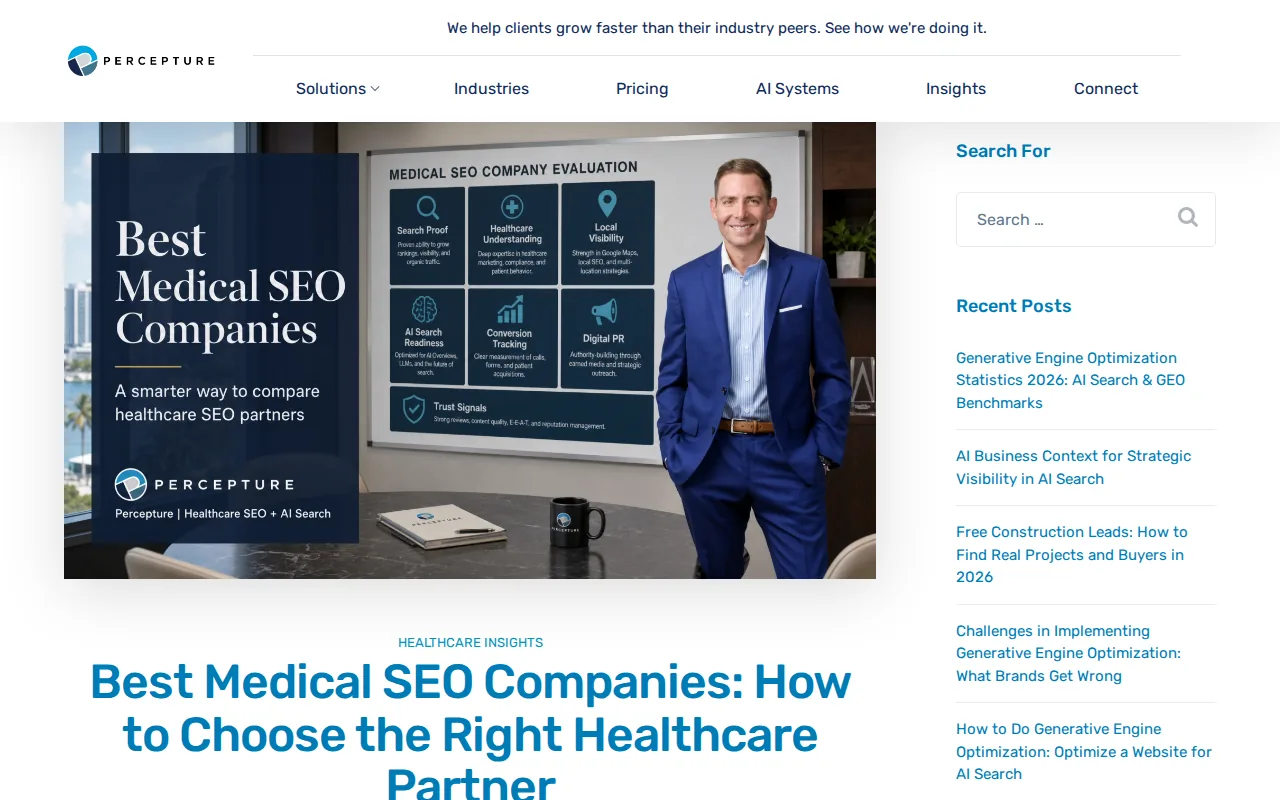
7. Percepture, Broad Digital Marketing Support for Larger Healthcare Teams
Percepture works with healthcare brands, health systems, and healthcare SaaS companies.
A health system with many service lines can spread the cost across a broad program. A small practice may need a narrower scope and a fixed monthly plan.
Before choosing a provider at this level, ask what the lowest tier includes. Does it cover local profile work, service pages, technical fixes, and measurement? Or does the base fee cover strategy while content, design, and development sit outside the retainer?
The source data does not give a full service list or contract structure. Treat the published range as a starting point, not a quote. You should also ask how the team manages clinical review and patient privacy when it produces content.
Best fit: Larger healthcare teams with enough budget to support a broad monthly program.
8. EGS Marketing Solutions, Direct Primary Care Growth Systems
EGS Marketing Solutions focuses on healthcare and has a stated differentiator for Direct Primary Care practices. Its system is built for practices seeking more predictable patient growth.
This narrower focus can be helpful when your business model depends on explaining membership, access, and ongoing care. The content plan should answer the questions that stop a patient from joining. It should also make clear which services are included and who the practice serves.
Local SEO still matters. A DPC practice needs an accurate profile, location-specific service pages, useful FAQs, and citations on the directories patients use. Reviews should reflect genuine patient experiences and must never reveal private health details.
Ask whether the plan includes technical work, content updates, analytics setup, and conversion tracking, rather than assuming the word “system” covers every part.
Best fit: Direct Primary Care practices with a membership-led growth model.
A niche clinic can still benefit from a clear local content plan. For example, a specialized provider may need pages that explain its care focus for patients searching by service and location. That is the kind of specificity a generic blog calendar often misses.
9. Onely, Technical SEO and AI Search Visibility for Complex Organizations
Onely is listed for mid-market and enterprise healthcare organizations with complex digital infrastructure. Its differentiator is proprietary conversation-intelligence technology for AI visibility.
This type of provider may fit a healthcare group with a large site, many systems, and a need to understand how AI tools describe the brand. The work should connect technical findings to patient-facing outcomes. A faster crawl is useful, but the clinic still needs accurate service pages and a clear booking path.
Ask how conversation intelligence is measured. Look for a repeatable set of queries, a record of brand mentions, changes over time, and links back to measurable site actions. Avoid reports that show only a few impressive examples.
Pricing and contract terms are not included in the research. The likely complexity also means your team will need a clear technical owner on the clinic side.
Best fit: Healthcare organizations with complex systems and a defined AI search measurement plan.
10. First Page Sage, Authoritative Content for Hospitals and Large Practices
First Page Sage is listed for hospital networks and large practices that need authoritative content that AI systems can cite. Its differentiator is a published GEO method tied to brand-centered thought leadership.
That focus fits organizations with subject experts who can review detailed health content. A physician, care lead, or clinical editor should still check every piece before publication. The agency can shape the question and structure, but the clinic owns the medical accuracy.
The best content plan won't treat blogging as a pile of posts. It should build service pages first, then add FAQs and supporting pages that answer real patient questions. A blog post is most useful when it supports a service, earns a relevant link, or helps a patient decide what to do next.
Large practices should ask how thought leadership is approved, how sources are cited, and how results connect to referrals or appointment requests.
Best fit: Hospital networks and large practices with expert-led content programs.
SEO Subscription Comparison for Medical Clinics
Choosing an SEO subscription for medical clinics is easier when you compare the operating model, not just the service label.
Provider
Best fit
Strongest angle
Known price or model
Watch for
Long Weekend
Small and mid-sized clinics
SEO plus PPC, branding, web design, and creative
Subscription, price not listed
Confirm medical workflow and monthly deliverables
Cardinal
Multi-location networks
Local, entity, technical, and persona-led SEO
—
May exceed the needs of one location
Intrepy
Specialty practices
Medical SEO, schema, and AI visibility
—
Ask how AI results are measured
WebFX
Practices and regional providers
Conversion-focused SEO and link acquisition
—
Clarify what is inside the base scope
Scorpion
Health systems and urgent-care networks
Multi-location control and Ranking AI
—
Confirm local approval workflows
SeoProfy
Complex medical groups
Technical audits, entities, and structured data
—
May need an in-house technical owner
Percepture
Larger healthcare teams
Broad healthcare digital support
$2,500 to $25,000+/month
Lower tiers may have narrower scope
EGS Marketing Solutions
Direct Primary Care
Membership-focused growth system
—
Check whether technical SEO is included
Onely
Complex healthcare organizations
Technical SEO and AI visibility
—
Define useful AI search measures first
First Page Sage
Hospitals and large practices
Authoritative, citable content
—
Plan for clinical review time
A fixed subscription can be attractive for a clinic that needs to plan cash flow, but fixed cost is useful only when the work inside the plan is clear. Reviewing SEO subscription pricing options can help you compare scopes and pricing structures before requesting proposals.
Key Takeaway: Long Weekend is the clearest match for clinics that want one monthly partner across SEO and related marketing work, while the other options fit narrower needs or larger organizations.
What to Look for in a Medical Clinic SEO Subscription
A monthly plan should begin with an audit and then show steady work against a short list of business goals. At minimum, ask for a baseline covering indexed pages, organic visits, local visibility, profile actions, lead events, and appointment outcomes.
Local search work
Local SEO should cover the Google Business Profile, map pack visibility, and citations. The provider should check name, address, hours, categories, services, photos, and review responses. Citation work should start with the directories that rank in your market or matter to your specialty. There is no need to chase hundreds of weak listings.
Each location also needs a distinct page with useful local detail. Swapping a city name into the same template can create thin pages that help nobody. A better page explains the local office, services, care team, access details, and patient questions for that area.
Content with clinical review
Content should map to patient intent. Service pages usually deserve priority over general blog posts. FAQs can cover preparation, costs, timelines, eligibility, and what happens at the first visit, provided the clinic approves the wording.
AI can help with outlines, content gaps, and draft organization. It should not publish medical claims without human review. Never place patient names, case details, images, or protected health information into an AI tool unless your legal and compliance teams have approved the process.
Technical SEO and site structure
The subscription should check speed, mobile use, crawlability, index status, redirects, internal links, and page structure. It should also track whether key pages remain available after a redesign. A clinic can lose valuable visibility when an old service URL disappears without a proper redirect.
Links, reputation, and personal brand
Healthcare link building should favor trusted local, professional, educational, and community sources. Digital PR may include a physician's expert comment, a local health event, or a useful resource that another site wants to cite. The clinic owner can also build search trust through a clear author page, a consistent bio, and useful public education.
Social media can support this work when it gives people a reason to search for the clinic by name. Facebook groups, Instagram, and TikTok may help with awareness, but likes alone are not an SEO result. Track branded searches, profile actions, referral visits, and leads.
Reporting that reaches appointments
Ask whether the provider uses Google Search Console, analytics, rank tracking, call or form events, and appointment data. Rankings are a useful diagnostic. They are not the final business result.
Set a review rhythm. Each month, the agency should state what changed, what was learned, what comes next, and which clinic-side task is blocking progress. If the report only shows traffic, ask for a path to patient actions.
Pro Tip: Before signing, request one sample monthly report and mark where it shows a search visit becoming a lead or appointment.
For a smaller clinic, this level of clarity often matters more than a long list of tools. If you want a broader view of subscription structures, compare the SEO subscription services for steady traffic growth before requesting proposals.
A medical clinic may also have a highly specific audience. A specialized practice such as a specialty clinic needs content that explains its services without turning sensitive care into shallow keyword copy. That example shows why the clinic's actual services should shape the SEO plan.
FAQ
What is the best SEO subscription for medical clinics?
The best fit depends on clinic size, location count, and the work you want bundled. Long Weekend is the clearest choice for a small or mid-sized clinic that wants SEO alongside PPC, branding, web design, and creative support. A large health system may need a specialist built for multi-site governance or technical infrastructure instead.
How much does medical clinic SEO cost per month?
Monthly medical clinic SEO pricing varies because providers use different scopes and contract models.
Does a medical clinic SEO plan need HIPAA compliance?
A medical clinic SEO plan needs privacy controls whenever the work touches patient information. SEO itself does not require access to protected health information, and most content can be built from approved service facts. Do not share patient names, records, testimonials, images, or case details with an agency or AI tool without pro.
What should local SEO include for a clinic?
Local SEO for a clinic should include an accurate Google Business Profile, useful location pages, key local citations, review guidance, and consistent business details. It should also track map pack visibility, profile actions, website visits, leads, and appointments. The goal is not to appear in every directory. It is to appear where local patients look.
How long does a medical SEO subscription take to work?
A medical SEO subscription needs time because technical fixes, new pages, local signals, and trusted links build in stages. Early work should establish a baseline and fix major access or accuracy problems. Ask the provider to set milestones for visibility, qualified leads, and appointment actions instead of promising a fixed ranking date.
Conclusion
For most small and mid-sized clinics, Long Weekend is the most usable first conversation because its subscription joins SEO with paid search, branding, web design, and creative support. Ask for a scope that names deliverables, privacy controls, reporting fields, and appointment tracking. Then request current pricing and decide whether the monthly work matches your patient growth goals.
Looking for the right digital marketing agency for your business — one that drives measurable ROI? Long Weekend helps service businesses, SaaS, ecommerce brands and more — grow with expert SEO, AI Search, Google Ads (PPC) management, paid social ads, website design, and more.