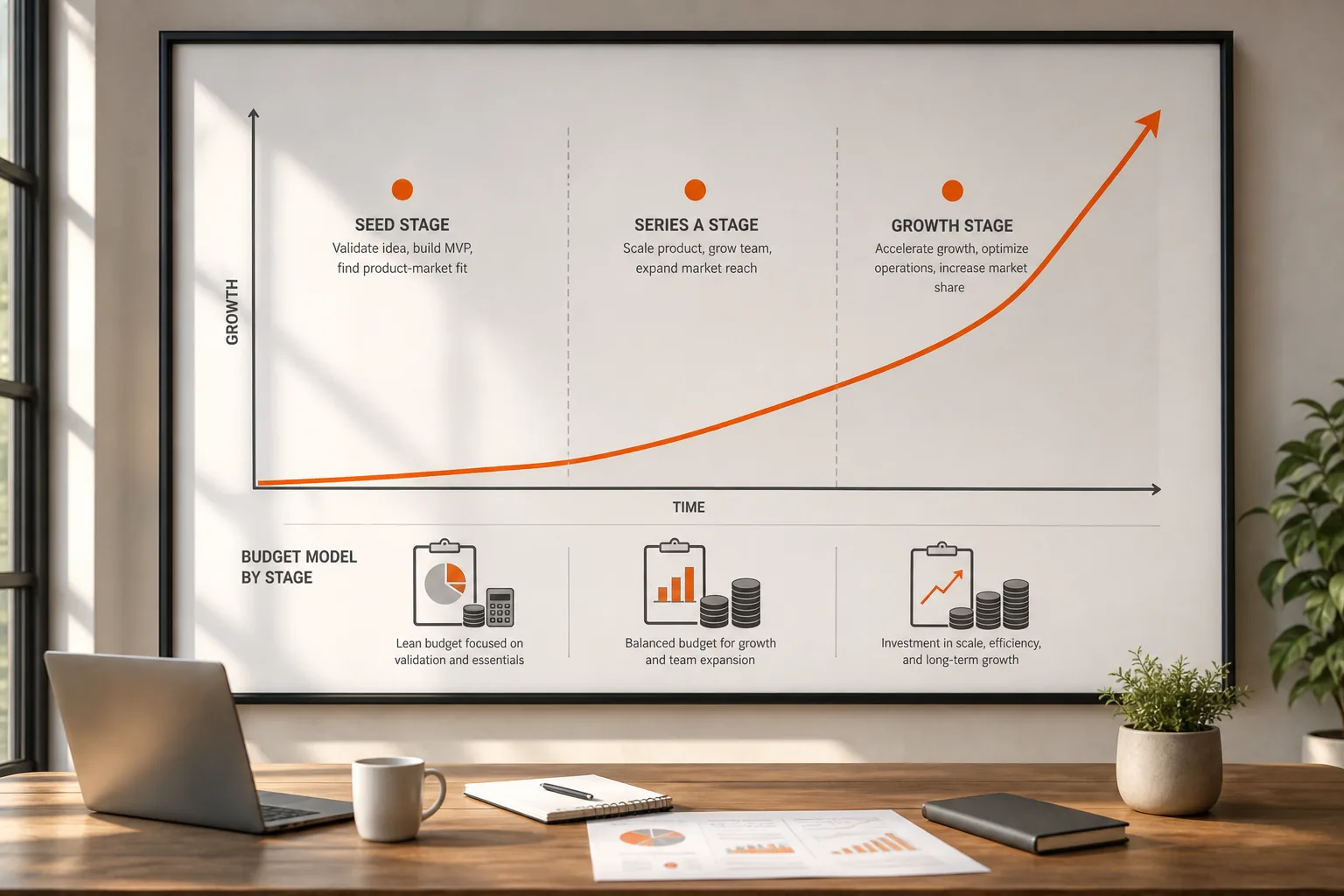
Most founders think a full‑service agency costs tens of thousands a year. In reality, you can start with a clear budget ceiling, pick a model that fits your stage, and spend wisely on the channels that move the needle. Below are the five steps you need to turn that idea into a working budget.
Step 1: Set Your Startup’s Marketing Budget Ceiling
First, decide how much you can afford to spend each year without jeopardising cash runway. A common rule is to tie the ceiling to a percentage of projected revenue. For early‑stage SaaS, founders often allocate a larger share of expected ARR; scaling companies reduce that share; mature firms sit at a lower proportion. Revenue projections should be realistic, use your sales forecast, not wishful thinking.
Next, factor in funding status. Venture‑backed startups typically spend more on marketing than bootstrapped peers. If you have a Series A, you can be more aggressive; if you’re self‑funded, keep the ceiling tighter.
Finally, add a buffer for unexpected costs, platform price hikes, new ad formats, or a sudden surge in demand. A 5‑10% reserve protects you from overruns and lets you test new ideas without breaking the bank.
Long Weekend’s subscription model starts at $0 and tops out at $556.25 per month, giving early founders a predictable ceiling while still covering PPC, SEO, branding, and creative production. Explore the full pricing guide to see how the ceiling maps to real‑world spend.
Key Takeaway: Set a ceiling based on ARR percentage, adjust for funding, and always keep a 5‑10% buffer.
Step 2: Choose a Budget Model Based on Your Growth Stage
With a ceiling in place, pick a budgeting model that matches where you are in the startup lifecycle. Early‑stage teams often use a “lean‑test‑scale” model: allocate a small fixed amount each month, run rapid experiments, and shift spend to the winning channel.
Mid‑stage companies benefit from a “funnel‑balanced” model. Split the budget across awareness, consideration, decision, and retention. This mirrors the allocation patterns found in a 2024‑2025 analysis of high‑performing B2B SaaS firms.
For mature startups aiming for category leadership, a “strategic‑reserve” model works best. Keep 18% of the budget in a reserve fund for seasonal pushes or sudden market opportunities, a practice that top quartile performers use to out‑pace rivals.
Long Weekend’s subscription gives you a flexible, month‑to‑month budget that can shift between these models without renegotiating contracts. See how the subscription adapts to each stage and why founders love the predictability.
Step 3: Allocate Spending Across the Right Marketing Channels
Typical allocations for a SaaS startup look like this:
SEO & content, 30% of the budget
PPC (Google, LinkedIn), 25%
Paid social, 15%
Email & automation, 10%
Events & PR, 5%
Reserve for testing, 15%
These numbers reflect the fact that organic search still drives B2B revenue, even though AI Overviews have cut CTR. Investing in quality content keeps that channel healthy.
If your product is visual‑heavy, consider shifting a few points to short‑form video.
Long Weekend can manage the whole mix for you, from SEO to paid social, under one subscription. Learn how they structure PPC spend and why that matters for early growth.
Pro Tip: Review channel performance every month and move at least 10% of under‑performing spend into the reserve fund for quick experiments.
Step 4: Connect Every Marketing Expense to a Measurable Goal
Every dollar you spend should map to a KPI. The most common metrics for SaaS startups are MRR, CAC, ROAS, and churn. Tracking these gives you a 360‑degree view of health and tells you if a channel is worth the spend.
For acquisition spend, calculate CAC by dividing total sales‑and‑marketing costs by the number of new customers acquired in the period. Aim for a CAC that is no more than 25% of the first‑year LTV, otherwise you’re burning cash.
Retention budgets should be tied to churn reduction goals. A 1% drop in monthly churn can add thousands of dollars to ARR over a year.
Long Weekend includes monthly reporting that ties each activity (e.g., a new SEO blog post) to the specific KPI it supports. This makes it easy to see which spend moves the needle.Use the video to ing dashboard.
For deeper reading on KPI basics, check out the customer acquisition cost resources and guidance on organic performance.
Step 5: Review, Test, and Reallocate Your Budget Monthly
Budgeting isn’t a set‑and‑forget task. Set a monthly cadence to audit spend, test new ideas, and shift money where the data says it belongs.
Start each review with a quick health check: compare actual CAC against the target, look at churn trends, and note any channels where ROAS has slipped more than 20% month‑over‑month.
Next, run a small‑scale test in the reserve fund, for example, a new TikTok ad creative or a guest post on an industry blog. Allocate no more than 10% of the reserve to any single experiment.
After the test period (usually 4‑6 weeks), evaluate the KPI impact. If the experiment lifts ROAS by at least 15%, move a portion of its budget into the main channel allocation. If not, pull the spend back and try a different angle.
Long Weekend’s subscription includes a quarterly audit that surfaces hidden costs (agency markup, overlapping tools) and suggests reallocation moves. Their clients often recover 8‑15% of their spend in the first audit cycle.
Key Takeaway: Treat your budget like a living document, review, test, and reallocate each month to stay efficient.
FAQ
How much should a startup spend on marketing in its first year?
The first‑year spend depends on your revenue target. A common benchmark is a larger share of projected ARR for seed‑stage companies, dropping as you scale.
What’s the best way to calculate my marketing budget ceiling?
Start with a realistic ARR forecast, apply a stage‑appropriate percentage (e.g., 30% for early growth), adjust for funding level, and add a 5‑10% buffer for unexpected costs.
Should I use a subscription agency or a traditional retainer?
A subscription agency like Long Weekend offers transparent pricing and the flexibility to shift spend month‑to‑month, which is ideal for early‑stage startups that need to stay lean.
Which KPI should I watch first?
Customer Acquisition Cost (CAC) is the most immediate indicator of whether your spend is sustainable; track it alongside Monthly Recurring Revenue (MRR) to gauge overall health.
How often should I reallocate budget?
Do a quick review each month, run larger audits quarterly, and be ready to move money after any test that shows a 15%+ lift in ROAS or a similar KPI improvement.
Conclusion
Start with a clear ceiling, pick a model that matches your growth stage, allocate to high‑ROI channels, tie every dollar to a KPI, and review monthly. If you want a partner that handles the heavy lifting while keeping costs predictable, reach out to Long Weekend for a free analysis and get your budget working from day one.
Looking for the right digital marketing agency for your business — one that drives measurable ROI? Long Weekend helps service businesses, SaaS, ecommerce brands and more — grow with expert SEO, AI Search, Google Ads (PPC) management, paid social ads, website design, and more.